Short answer: Report it from your business profile; don't ignore it or delete it yourself (you can't), and respond calmly and publicly while you wait. Google resolves most reports within a few days, but only removes what violates its policies: an unfair negative review cannot be removed, but a review from someone who was never your customer can. If the report fails, there's a second option.
The uncomfortable part is this: the success rate isn't high, and chasing down every unfair review usually costs more than it pays off.
First, distinguish what type of review you have
This determines everything else, and almost nobody does it well.
Fake review. It was written by someone who was never a customer. A competitor, a bot, a coordinated campaign. It can be removed.
Review with conflict of interest. It was written by an employee, a supplier, a family member. It's also removable, and on the other hand: if your brother-in-law gave you five stars, that also violates the policy.
Review that violates content requirements. Insults, personal data, advertising, sexual or discriminatory content. Can be removed based on its content, even if the customer is real.
Legitimate negative review. The customer went, had a bad experience, and told their story. It hurts, but it can't be fixed, and reporting it is a waste of time.
Review with identity error. He went to the wrong business, a common occurrence with chains and stores with similar names. Reportable.
The most common mistake is reporting the fourth category thinking it's the first. Google reviews it, keeps it, and you end up with a failed report.
Why are fewer fake ones appearing than before?
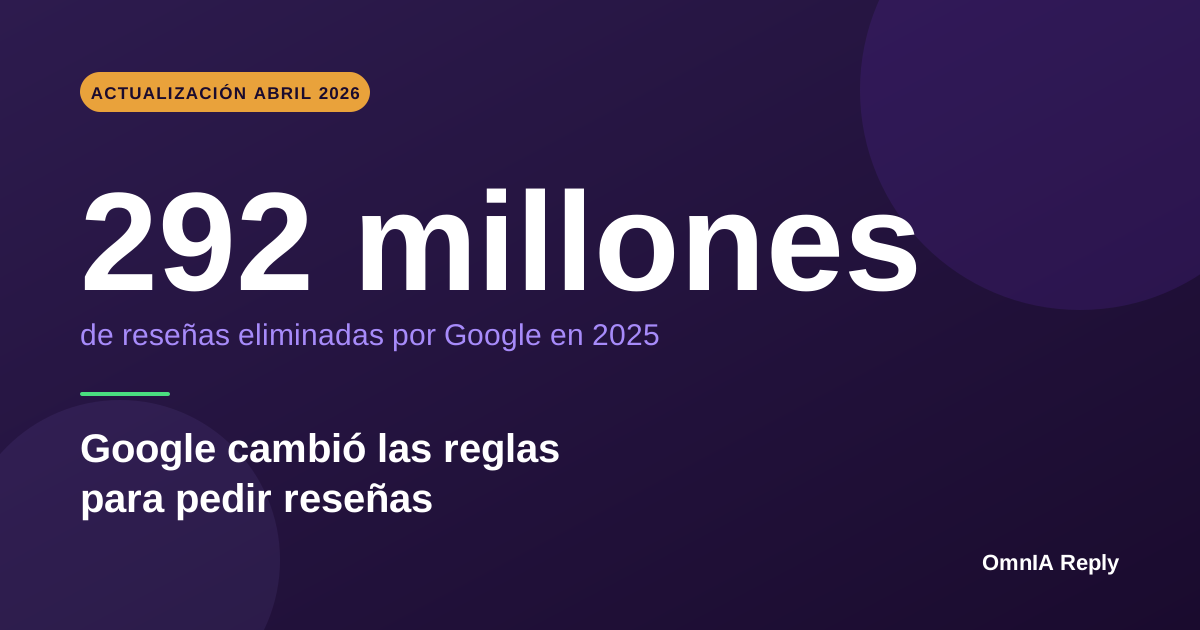
Google significantly tightened moderation during 2026. Its 2025 Trust and Safety Report states that it blocked or removed 292 million reviews that violated policies, and in April it announced that moderation would be powered by Gemini.
The pre-evaluation process has also changed: it now considers account history before publishing. New, inactive accounts that leave a five-star rating are immediately flagged for review. The same applies to a one-star rating from a newly registered competitor.
Practical translation: much of what used to have to be reported is no longer published. And what is published and passes the filter is harder to take down, precisely because it has already been reviewed.
The process, step by step
1. Document before touching anything.
Take a screenshot with the date, author's name, full text, and rating. If the review is later deleted, you won't be able to retrieve the evidence, and you'll need it if you upgrade.
2. Check the profile of the person who wrote it.
Click on their name. Look at how many reviews they have, when they're from, and whether they're all in the same city or area. A profile with three negative reviews for three competitors in the same neighborhood in the same week is a pattern. Document it.
3. Report it from your company profile.
Search for your business on Google, go to the reviews section, find the review, and use the report option. Choose the most relevant reason, not the one that sounds the most serious.
4. Respond publicly while you wait.
This is what's most often overlooked. The answer isn't for the author, it's for whoever reads it later. Use a neutral tone, avoid accusations, and include verifiable information if you have it.
Example:
We checked our records and found no visits or orders with this information. If there was a problem with us, please write to us at [email] and we'll gladly look into it.
That tells the reader that you did your research, without calling anyone a liar.
5. If nothing happens, scale up.
Reports take time. If it's still there after seven or ten days, use the review management tool on your business profile to check the status and request a review. That's where you provide the documentation from step 1.
6. Legal action, only in clear cases.
If there is defamation based on specific falsehoods, or a demonstrable coordinated campaign, legal recourse is available. It's slow and expensive. Reserve that option for real and quantifiable harm, not for an undeserved celebrity.
The strategy that almost always works best
Let me tell you straight: most fake reviews are not removed.
The defense that does work is dilute. One fake review out of twenty others does damage. Out of three hundred, it's just background noise. A business with a steady stream of legitimate reviews is virtually immune to targeted attacks.
And this has an additional advantage: it can be done today, without depending on Google to solve anything.
However, do it within the rules. Rushing to solicit reviews after an attack can be worse than the attack itself: Google flags unusual spikes in volume as a sign of manipulation, regardless of intent.
Frequently Asked Questions
Can I delete a review from my profile?
No. Only Google can do that, after reviewing a report. Nobody can delete reviews on their own, and anyone offering that service for money is either selling snake oil or worse.
How long does it take Google to respond to a report?
Usually between a few days and a couple of weeks. There is no guaranteed delivery time.
Is it worth responding to a fake review?
Yes, even if I don't delete it. The response is read by potential customers, and that's where credibility is restored.
Can I report a negative review that I feel is unfair?
You can, but if the customer is genuine and simply dissatisfied, Google will uphold it. A negative review doesn't violate any policies.
What if a competitor attacks me with several reviews?
Document the pattern: profiles, dates, coincidences. A coordinated attack is easier to prove than a false alarm, precisely because it leaves a trace.
Can I pay to remove reviews?
This service does not exist legitimately. Furthermore, offering an incentive for someone to remove or modify a negative review is expressly prohibited.
Do employee reviews count as fake?
These count as a conflict of interest and are prohibited. If your team left reviews for your own business, they can be removed.
What you should have ready before it happens
When an attack occurs, improvisation is difficult. Have a clear plan in place for who reviews new reviews, how often, and who writes the responses. An attack detected within three hours can be managed; one detected after three weeks has already done the damage.